Personally, I thought Swinburne's translation of the poem was absolutely fantastic. The undying love that you could almost piece together through Sappho's "Fragment 31" seemed a lot more put together when Swinburne wrote it. Sappho's heated love for Anactoria and her desire to want to live on after her death gave the poem a new meaning to me, as I first thought it was all just a sappy love poem, which I've definitely read my fair share of.
However, it does bring up the interesting question of whether Swinburne got a little too creative with the translation, knowing his type of writing, but still, I felt it was very helpful it allowing me pin down the meaning of Sappho's work and maybe even fill in some of those gaps.
I agree with Daniel, about how the translation wasn't just like any other, if I may quote you, "sappy love poem". It was beautiful, containing more than just a someone's expression of love, but what the death of that love meant for their life. Usually, when you read a poem of this nature, it speaks of dying love as if it is the death of the speaker as well, that a life past that is unthinkable. In fact, the concept is so common in poetry, I had to go back and re-read to make sure I hadn't misread anything. So, to me, it represented more than just a woman's love, it was also about her own strength.
I have to be the contrarian, I suppose. To my eye, the translation was blockish and heavy, difficult to get through, and lacked the original's concise expression of love. Even though much of the original Greek is lost, it is still easy to see that Sappho managed to say much more with much less than the subsequent reinterpretations.
I'm with Olivia on this one. While it was a challenge and pleasure (for those who enjoy analyzing literature) to read and interpret the many potential points and meanings of Sappho's original "Fragment 31", Swinburne's translation left little to the imagination and as Olivia stated, was very difficult to get through. While I applaud the expansion that he was able to make on the poem, I also feel it takes away from Sappho's writing and can almost be interpreted and read as a completely different entity.
I think that one of the most notable differences between the two poems - and the reason that I prefer Sappho's original piece - is the difference in tone. "Fragment 31" describes an overwhelming love and passion, and the jealousy that arises from that passion since Sappho is unable to be/has not yet confessed herself to the beloved. While not it's official ending, the last line of the poem as we modernly know it ends with a gesture toward hope, in which Sappho says that "all is to be dared", perhaps optimistically implying that she is going to confess her love.
So, whereas I interpret "Fragment 31" as more of an earnest, "romantic" love poem, Swinburne's creative re-imagining is much more dark, carnal, and even violent in its message toward love. “Anactoria” has a much more bitter, spiteful tone at its end in which Swinburne’s Sappho spurns all notions of her beloved and love itself, in favor of the lasting value of Sappho’s legacy. Sappho rejects her own rejection by implying that it doesn’t matter – both her beloved and love cannot escape death, whereas Sappho’s art has the ability to become immortal. Swinburne’s poem is almost an anti-love poem when compared to Sappho’s original work, and I find it interesting that Swinburne chose Sappho’s poetry in particular to re-work, since I find them to be dramatically varying in their assessments of what it means to have an unreciprocated love.
As a poetry lover, I think I have to agree with comments that were already stated. I felt as though the translation took away from Sappho's original work of "Fragment 31". Again, like others have already noted, I do applaud him on coming up with his rendition of poem in his own words, however, it wasn't as much as a joy to read as Sappho's original work. Maybe i'm "hating" on him because I have issues with people re-doing others peoples work but again, its Sappho! There is not much topping of something that is already good. Sappho's notion of jealousy and or love for another female is just entertaining to read, if you like the whole gay erotica thing. The choice of words she uses that we can see, speak far more than the translation with its complete sentences and full on metaphors and imagery.
I also believe that the ambiguity of Sappho's poem made it the more interesting read. While it was nice to have some of the blanks filled in with a more elaborate tale via Swinburne's interpretation, I felt that it may have taken away from the original intent. Swinburne's version of the poem spelled out exactly what was happening as opposed to the imagination needed for Sappho's poem. Although it was a nice interpretation of Sappho's poem, I felt that Swinburne's was very dense and lack the same kind of passion felt in Fragment 31.
There are simply far too many interpretations of old, incomplete texts such as this. While some may insist on giving one's own interpretation, the possibilities are enormous for misinterpretations as well. I can almost see Sappho coming back from the grave, shaking her head in disappointment, and re-burying herself out of frustration. What is really interesting, however, is to see how disparately different scholars translated the work, as can be seen at: http://www.sappho.com/poetry/sappho2.html
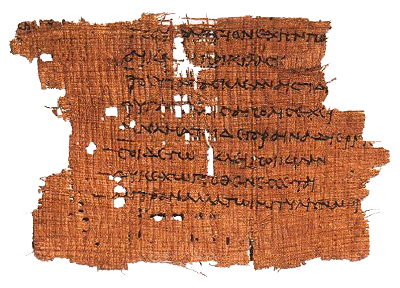

Personally, I thought Swinburne's translation of the poem was absolutely fantastic. The undying love that you could almost piece together through Sappho's "Fragment 31" seemed a lot more put together when Swinburne wrote it. Sappho's heated love for Anactoria and her desire to want to live on after her death gave the poem a new meaning to me, as I first thought it was all just a sappy love poem, which I've definitely read my fair share of.
ReplyDeleteHowever, it does bring up the interesting question of whether Swinburne got a little too creative with the translation, knowing his type of writing, but still, I felt it was very helpful it allowing me pin down the meaning of Sappho's work and maybe even fill in some of those gaps.
This comment has been removed by the author.
ReplyDeleteI agree with Daniel, about how the translation wasn't just like any other, if I may quote you, "sappy love poem". It was beautiful, containing more than just a someone's expression of love, but what the death of that love meant for their life. Usually, when you read a poem of this nature, it speaks of dying love as if it is the death of the speaker as well, that a life past that is unthinkable. In fact, the concept is so common in poetry, I had to go back and re-read to make sure I hadn't misread anything. So, to me, it represented more than just a woman's love, it was also about her own strength.
ReplyDeleteThis comment has been removed by the author.
ReplyDeleteI have to be the contrarian, I suppose. To my eye, the translation was blockish and heavy, difficult to get through, and lacked the original's concise expression of love. Even though much of the original Greek is lost, it is still easy to see that Sappho managed to say much more with much less than the subsequent reinterpretations.
ReplyDeleteI'm with Olivia on this one. While it was a challenge and pleasure (for those who enjoy analyzing literature) to read and interpret the many potential points and meanings of Sappho's original "Fragment 31", Swinburne's translation left little to the imagination and as Olivia stated, was very difficult to get through. While I applaud the expansion that he was able to make on the poem, I also feel it takes away from Sappho's writing and can almost be interpreted and read as a completely different entity.
ReplyDeleteI think that one of the most notable differences between the two poems - and the reason that I prefer Sappho's original piece - is the difference in tone. "Fragment 31" describes an overwhelming love and passion, and the jealousy that arises from that passion since Sappho is unable to be/has not yet confessed herself to the beloved. While not it's official ending, the last line of the poem as we modernly know it ends with a gesture toward hope, in which Sappho says that "all is to be dared", perhaps optimistically implying that she is going to confess her love.
ReplyDeleteSo, whereas I interpret "Fragment 31" as more of an earnest, "romantic" love poem, Swinburne's creative re-imagining is much more dark, carnal, and even violent in its message toward love. “Anactoria” has a much more bitter, spiteful tone at its end in which Swinburne’s Sappho spurns all notions of her beloved and love itself, in favor of the lasting value of Sappho’s legacy. Sappho rejects her own rejection by implying that it doesn’t matter – both her beloved and love cannot escape death, whereas Sappho’s art has the ability to become immortal. Swinburne’s poem is almost an anti-love poem when compared to Sappho’s original work, and I find it interesting that Swinburne chose Sappho’s poetry in particular to re-work, since I find them to be dramatically varying in their assessments of what it means to have an unreciprocated love.
As a poetry lover, I think I have to agree with comments that were already stated. I felt as though the translation took away from Sappho's original work of "Fragment 31". Again, like others have already noted, I do applaud him on coming up with his rendition of poem in his own words, however, it wasn't as much as a joy to read as Sappho's original work. Maybe i'm "hating" on him because I have issues with people re-doing others peoples work but again, its Sappho! There is not much topping of something that is already good. Sappho's notion of jealousy and or love for another female is just entertaining to read, if you like the whole gay erotica thing. The choice of words she uses that we can see, speak far more than the translation with its complete sentences and full on metaphors and imagery.
ReplyDeleteI also believe that the ambiguity of Sappho's poem made it the more interesting read. While it was nice to have some of the blanks filled in with a more elaborate tale via Swinburne's interpretation, I felt that it may have taken away from the original intent. Swinburne's version of the poem spelled out exactly what was happening as opposed to the imagination needed for Sappho's poem. Although it was a nice interpretation of Sappho's poem, I felt that Swinburne's was very dense and lack the same kind of passion felt in Fragment 31.
ReplyDeleteThere are simply far too many interpretations of old, incomplete texts such as this. While some may insist on giving one's own interpretation, the possibilities are enormous for misinterpretations as well. I can almost see Sappho coming back from the grave, shaking her head in disappointment, and re-burying herself out of frustration. What is really interesting, however, is to see how disparately different scholars translated the work, as can be seen at: http://www.sappho.com/poetry/sappho2.html
ReplyDelete