
Thursday, November 29, 2012

Daddy in the Walls.
Reading Alison Bechdel’s recounting of her estranged relationship
with her father seemed so familiar to me. I wasn’t entirely sure why I felt
this way, at first, but then, it hit me. His cold, detached attitude reminded
me so much of my own father.
Okay, so here’s the short version of my life in relation to
my parents’ ill-fitted marriage.
They met in Med school. My mom’s dad had just died. She was
lonely, and they were both falling for a delusion they mistook for love. They married. And then
they added kids to the mix. Smart, eh?
It was no big secret my father NEVER quite enjoyed the
company of children—something that unfortunately seemed to transcend into his
relationship with his own children. Planned and expected, by my father, I was
referred to as the baby or her baby (subtly abdicating any
responsibility over me to my mother).
I guess I should share
that I have spoken to my father about this. He claims to have felt an immediate
connection to me the day I was born, changing his earlier sentiment. I've always felt torn between what to blame for his behavior: my father’s naturally scientific and
critical personality or his and my mother’s unhappy marriage. Nowadays, I
imagine the latter being the direct result of my father’s impossibly
unemotional demeanor.
Growing up, my father had installed an office space in our
house that was supposed to be restricted to him only. Being the curious, rambunctious
children my little brother and I were, of course we ignored any boundary drawn
around this new space. Both my parents worked a lot, so we took full advantage
of the time we had to explore his work space (that is whenever our nanny didn’t
catch us). The very thought of our chubby, dirty fingers smearing and smudging
his cheap bookcases and outdated Microsoft computer absolutely sent him
bananas.
It would be a careless understatement to simply call him a
neurotic perfectionist.
For years, I wondered
how my father dealt with it. I was always reminding myself of how he slept in the
guest room on the other side of the house. How he yelled at us so often. How he
stormed into his office, locking himself away for the rest of the night. It was
much more difficult to convince myself that underneath his blatant misery, he
loved me.
Bechdel’s depiction of her relationship with her father is
so tragically candid. Every aspect of their interaction is laced with tension.
This does not seem falter, even at his deathbed. She retells of her unusually awkward
interaction with her deceased father. After presenting us with some imagery
referring to her father’s “rough and dry, scraped clean” face (Bechdel 51), “wiry
hair…brushed straight up on end”, and “tiny blue tattoo on his knuckle”, she
then admits to paying her respects for “as long as [she and her brothers]
sensed it was appropriate” (Bechdel 52). Obviously, her disconnected manner of
regarding her father stems from years of mistreatment and neglect and an
unconventional upbringing (as is explored through her sharing of the family
business). Yet, it is on page 86 that I begin to understand why she might have decided to share this story in the first place.
After years of struggling to claw through my dad’s thick
shell in search of some inkling of adoration, I understand what it is to grasp
onto a single strand of hope for connection. The least I can say is it’s gotten
a lot easier to feel something more than the reverberating sound of his office
door slamming on the walls.
I credit that to divorce.
Wednesday, November 28, 2012
"Fun House" Hits Home
As
discomfiting as it is to admit, most of my favorite childhood memories of my
father are when he was drunk. Much
like Alison Bechdel’s, mine is not a “physically expressive family” (19), and
only in infrequent instances is it even a verbally expressive one. So, on the
rare occasions when my mother had to drive my father home from an evening out,
I learned to look forward to the uncharacteristic affection that he inevitably
lavished on me, his normally stoic demeanor uninhibited by alcohol.
It became something like a ritual – he would go into the living room and turn on an old, live in concert, U2 DVD, at which my mother would roll her eyes and head off to bed, and, after the first two or three songs, I’d casually wander into the living room. My father would invite me onto the couch, where I curled up against his shoulder. Then, without fail, he would bemoan the downfall of modern music and boast about how great the oldies were, and I would ignore it, thrilled just to be cuddled up next him while he stroked my hair, to have this physical confirmation that he loved me. I suppose it’s kind of sad in some ways, but to me it’s simply familiar; my father is the way he is, and it’s difficult to begrudge him that.
In “Fun Home”, Alison Bechdel seems to struggle with a similarly dysfunctional relationship with her father, despite the fact that her novel thus far pays a hefty tribute to him. She employs a wide range of literary allusions when referring to her father, a nod to his position as an English teacher and love of reading, and there is also a fixation on death, attributed to her father’s work as a mortician and his death for which Bechdel feels in some way culpable.
As Bechdel says on page 22, “although I’m good at enumerating my father’s flaws, it’s hard for me to sustain much anger at him.” I think that this stems from a difficulty in reconciling the guilt Bechdel feels surrounding her father’s death, and the sometimes confusingly inexplicable love children feel toward their parents, with the man that her father actual was: reserved, abrasive, and volatile.
There is a metaphor used on page 22, in which Bechdel describes her father bathing her as a child, where she says, “The suffusion of warmth as the hot water sluiced over me… the sudden, unbearable cold of it’s absence.” I found this metaphor to be poignant in embodying the hardship of being a child desperate for parental affection; the “unbearable cold” of apathy overwrites the logic that perhaps seeking approval from such a dubious father figure is not a worthy goal.
“Fun House” is the text I've related to most during this course. I think one of the most amazing things a writer can do is capture, in words, some perfect sentiment or representation of the human experience, and Alison Bechdel has (for me) achieved this several times over just within the first 100 pages.
P.S. Professor S will be pleased to know that that Oxford English Dictionary and I spent a lot of quality time together during this reading!
Sunday, November 25, 2012
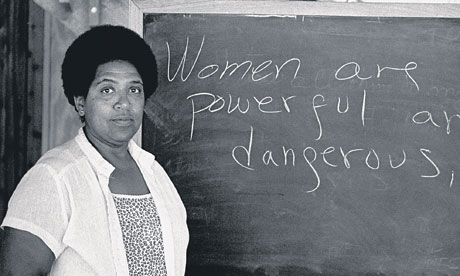
Monday, November 19, 2012
Exploring the limits
While reading Zami, I first failed
to acknowledge that I had any personal connections to Audre Lorde experiences
at all. And that’s where I made my first mistake. I personally do not think
that there is anyone who could not relate to the themes found in this book.
As young adults and college
students, we take this time to explore things we’ve never gotten to explore
before whether that be with drugs, sex, music, clothes, knowledge or any type
of experimentation you’d be interested in. We make mistakes, and we learn and
grow from them (or you don’t). With these next chapters, this is exactly what
Lorde seems to be doing. Lorde seems to struggle the most with her isolation
during her youth but grows confidence and acceptance as she grows older. Going
to college, moving out, getting a job, Dealing with the suicide of her first
love Gennie and carrying the memory of her where ever she goes, Getting
pregnant at a young age, Having an abortion, the list goes on and that’s what I
feel is so beautiful and connecting about Audre Lorde’s writing, she allows you
to connect with her experiences. She creates this person who deals with so many
obstacles and you can’t object or hate her for it because the experiences are
so real!
As a gay boy, I expected to read
this book and find very minimal connections to any part of this book and I was
completely wrong. Audre Lorde just continues to capture my attention with these
life experiences or moments that are filled with such emotions that are just so
real you just cant pull away from the book. This is by far my favorite book of
the semester and I look forward to seeing how this ends.
On a completely different note, I
found a very small detail within the book that I found very interesting and I
wanted to get different opinions on what the possible reason for certain
spelling choices Lorde makes within her biomythography symbolize. I first
noticed in chapter 10 page 69 that the word America was spelled with a
lowercase “a” instead of a capitalized one and then reading further she does
the same with the word America. She only does this with America, when she
mentions any other country, she will capitalize the name. I just found this
very interesting and I formulated a possible reason but wanted to get other
opinions.
-Johnny Benavidez
-Johnny Benavidez
Thursday, November 15, 2012
Response to ZAMI
“Be kind today my sweet boy and pray for those who are unkind for you. Now get out and go learn boy.”
I remember my mom telling me this most every school morning as I eagerly jumped out of our gold minivan to run inside to my friends. My naive young self never did realize how serious my mothers sayings were. I was foolish to the harsh realities of the world. I never saw the turned up brows or heard the scoffs thrown in my families’ direction as my white mother walked through the H-E-B with her three mixed children. All I knew is that if my sisters and I kept listening to our walkmen and didn’t make a scene we would all get to pick a piece of candy when it was time to check out. I never had to deal with much of anything thanks to my mother’s protective reign. Where we went to school, what neighborhood was safest, where we would shop. Everything move she made was made with my sisters’ and my own safety in mind. And, because of this, I never really understood why my mother was so afraid. Her careful planning kept me away from the evils of racism of which she knew. I had friends of every color growing up, not that I knew it at the time. We were all just kids playing together. I never had to deal with much any racism in the way my parents did.
When my mother was 18 she announced to her mother, my future grandmother, that she was in love with my father, a black man. Hours later she was out the door, 3 suitcases in hand, completely disowned. My mothers first personal experience with racism came from the woman who gave her life.
As I flipped through this novel I found it so easy to connect with on a personal level because my parents went through the same things in regards to racism. As Audre recalled moments of her mother protecting her from the cruelness of the world, I too recalled specific moments of my mother protecting me from a hurt she knew all too well.
When I grew older I questioned my mothers protectiveness. My life was so easy, ya know? I never had any real experience with racism and in my mind she was being paranoid. Upon entering high school she gave me my first day of school speech and, of course, reminded me that there were dumb people out there that would have ignorant things to say, but before she could finish I cut her off. “I get it!” I remember screaming, “You tell me the same thing all the time and it is so annoying!” I don’t know where it came from, to quote the greatest movie of our generation, “it was like word vomit,” and I instantly regretted it because crossing my mother was and still is something no one should do. Expecting a quick slap I remember trying to brace myself without looking like I was on the off chance that she somehow wasn’t about to kill me, which, to my surprise, she didn’t. She starred at me for an almost uncomfortable amount of time and then very calmly went up the stairs to her room returning a few moments later with a old box i hadn’t seen before in her hands. She rifled through it for a moment and then placed a picture in my hand that appeared to be a portrait of her at the age of 20 after she had been in a severe fight. I had seen some pretty raunchy fights at school, but there was something about seeing my mom with chunks of her hair missing, gashes on her face, and blood dripping from her nose that made me uncomfortable to the point of feeling physically weak.
“You know what happened?” She asked in a way that really said, “You’re about to feel like a dumb bitch for going off on me, young boy.”
“What?” I uttered.
“When your father and I moved in together for the first time I got my ass beat by the group of girls that lived above us.” She didn’t have to say why because we both knew. “I know you don’t always want to hear what I have to say, but I say the things I do for a reason. You may not want to hear my words, but you’re going to and you’re going to respect them because I’m the only person in this world who cares about you every second of every day.”
I love this book because I see myself and my mother in it time and time again.
Ps, the movie of our generation is Mean Girls. Deal with it.
Wednesday, November 14, 2012
Zami: A New Spelling
of My Name by Audre Lorde
There is something about this
particular author that is very endearing. She is real and she captures your
attention with her extremely detailed descriptions of her life in this
“biomythography”. In the first 11 chapters of the book, you get an
understanding of how Audre grew up and her experiences as a child. Growing up
in the WWII era in New York City, her parents were immigrants from Grenada.
Audre describes herself when she is a child as being “fat, Black, nearly blind,
and ambidextrous in a West Indian Household” (24). She is teased and called
names for being different. Even within her family, she feels like the oddball. I feel like a lot of people can relate to being the black sheep of the family and feeling isolated to others around them, which helps in connecting more with the book. Her two sisters, Phyllis and Helen, are very close in age and have a bond that
is not shared with Audre. She longs for companionship. Audre faces the harsh
reality of racism, especially in school. It angered me to read about how she
was treated in class and how her teachers (which were nuns) thought of her as
below them.
On the topic of sexuality, Audre explains some very interesting feelings and
observations. Her feelings towards her mother are sometimes questionable and
confusing. In a way, I feel like Sigmund Freud’s Oedipus complex comes into play here.
Audre admires her mother; however, in her recollections and descriptions of her
mother aren’t the norm. For example, “Years afterward when I was grown, whenever
I thought about the way I smelled that day…I would have a fantasy of my
mother…looking down upon me lying on the couch, and then slowly, thoroughly,
our touching and caressing each other’s most secret places” (78). This
parallels with her memory of Toni. At four years old, Toni sparks Audre’s
curiosity. This part in the book is a little mind-boggling for me. It is
extremely erotic for the inner monologue of a 4-year-old. Wanting to “undress”
and “touch” isn’t exactly what’s on the agenda for the average toddler. But
perhaps her admiration for her mother as well as this new curiosity with Toni
is the budding growth of Audre’s sexuality and love for women. The meaning of "Zami" is women who work together as friends and lovers! When she first menstruates
at 15, she embraces her womanhood. She explains, “My body felt new and special
and unfamiliar and suspect all at the same time. (77). As a woman, I appreciate this adoration for fellow women. It is a bond, a sisterhood that makes me happy. I’m anxious to keep reading about her endeavors further on in the book.
Monday, November 12, 2012
"The Empire Strikes Back" - an elegant response to an inelegant attack
I
cannot help but think back to that first day in class when we chose about which
article we were going to blog. I can admit I selected this one simply for its
slightly misleading title, but on reflection I am glad I did because
transsexualism is likely the topic with which I am least familiar on our
syllabus. Very early in the reading (and the title) it states that this text is
a counter-argument to another text, so wanting to get both sides of the story,
I also read The Transsexual Empire: the Making of the She-Male by Janice
Raymond. While the authors are clearly at odds on some issues, surprisingly
more often that not common ground could be found between the two.
Sandy
Stone is a transgender scholar often credited as a founder of modern
transgender studies. Additionally, she established the ACTLab here in the
unversity’s Radio-Television-Film department in 1993. Stone’s work with Olivia
Records, an all-women recording company is that with which Raymond takes
offense. As a very adamant lesbian-feminist, she says in no uncertain terms
“transsexuals are not equal to women and are not our peers” (Raymond 117) and
quotes a male-to-female transsexual several times throughout who claims that
being “free from the chains of menstruation and child-bearing, transsexual
women are obviously far superior” (Raymond 117). Whereas Raymond’s text came
across as something that should be shouted from a pulpit while banging one’s
fist repeatedly (an image she is partly responsible for creating by relating
modern day medical procedures for gender reassignment surgery to the medical
practices of Nazi Germany), Stone’s text identifies many of the same problems
Raymond highlights but presents them in a less off putting manner.
Common
to both texts is that society is largely at fault for creating a feeling of
gender dysphoria. Because gender roles are so rigidly enforced, one is not
allowed to express gender inappropriate behavior. Stone highlights this by
presenting four (auto)biographical cases of transsexual transformation. In each,
a “binary, oppositional mode of gender identification” (Stone 225) is
reinforced. Raymond takes this a step further and presents studies that show
“transsexuals are more what the culture expects women to be than are those who
were born female” (Raymond 80). It is precisely this behavior with which
Raymond takes the most offense; she believes that rather than attempting to
combat sex-role stereotyping, those than undergo gender reassignment only serve
to further and perpetuate such stereotypes. Stone acknowledges this is a
problem, especially in a group whose ultimate goal is to “pass” or blend into
society in their new role without being discovered, thus ending any further
discussion to be had. Stone visualizes a future in which transsexuals allow themselves
to be known so that a discourse could be opened challenging socially accepted
gender norms. Raymond has a much more pessimistic outlook, believing that
because it is so difficult to affect change on a social level, transsexuality
is focused on as an individual problem which prevents the large-scale change
for which feminists hope.
Stone
concluded with a powerful statement to this effect, “although individual change
is the foundation of all things, it is not the end of all things. Perhaps it’s
time to begin laying the groundwork for the next transformation” (Stone 232). I
could not help but think of the slogan “we’re here, we’re queer, get used to
it” while reading Raymond’s book. While both texts raised legitimate concerns,
Stone’s positivity allowed for a much more honest connection with what she had
to say than I could establish with Raymond’s. It truly is a credit to Stone’s
character that she could respond with an argument so elegantly without having
to stoop to vicious rhetoric and personal attacks; if I had to side with one or
the other with regards to who had transcended stereotypical bickering that
surrounds a divisive issue in society, I would without a doubt side with Sandy
Stone.
Works Cited
Raymond, Janice. The Transexual Empire: the Making of the She-Male. Boston: Beacon
Press, 1979. Print
Stone, Sandy. “The Empire Strikes Back”. The Transgender Studies Reader. Ed.
Susan Stryker and Stephen Whittle. New York: Routledge, 1987. 221-235. Print.
Wednesday, November 7, 2012

Monday, November 5, 2012
So pick that guitar up, and come back to yourself, so you can be free.
"I will carry on/ I will come back/ I will grow more powerful/ I will remember"
“Love
conjure/ Blues” is a seething mess
of emotion and thoughts and events that all run together into something that is
almost indecipherable at times.
However, I think it is a perfect way to portray the characters and the
desperate nature of their experiences.
The
language itself was baffling, and reminded me of having to read “Huckleberry
Finn” aloud to myself during high school, which was the only way I could
comprehend Jim’s dialect. Even though this is clearly not academic
English, I think this was a way for the author to fully submerse the reader in
the experiences she was having and help to include the reader in every way
possible. As for the culture
itself, I was at a loss, finding myself almost completely unable to relate to
the language spoken and the particular events happening around these people.
My
favorite aspect, however, was the consistent underlying theme of characters being forced to confront their own flaws.
Only then could they conquer their pasts. On page 59, Red asks Peachy for help with her dreams, and
Peachy confronts Red about her “gotdamn evil ass heart,” and later says, “I
can’t go back/but I sure as hell can move forward”(59-60). In my absolute favorite scene in the
book, Lushy takes Bettye outside of the nightclub to beg to get her back; “Fo
all the ways I acted a fool and I know I was wrong/ and I was sho nuff wrong/
for fucking change bettye. I am sorry honey. I am sorry,” (66-67). The entire speech was moving, and the
last lines sum it up pretty well.
He needed to be honest about himself before he could make someone else
happy.
A
great thing about this kind of literature is that, hopefully, everyone can find
a character or event and be able to relate to it personally. When I read this book, I instantly
thought of something I wrote about a year ago.
Hands.
They are not perfect, these hands of mine.
They seem to have aged past my years, past what youth
Hurtling into an unsteady world of adulthood that I often
don’t understand
Dirty fingernails, scars criss-cross their backs
They have been there for me, though. They are mine.
Dusted off my shoulders
Lifted me out of places I should have never been
And other places where many hands go
They have worked, they have sweat
Clumsily running a brush over canvas
Flicking the butt of my guilty habit
Packing, unpacking. Never sure of where they will end up
And they have held other hands
Hands of mother and father, hands of loved ones
Some that were not right for them
This is only very first part of the
poem, but I wrote it for myself, because I could feel the weight of my troubles
bearing down on me. At some point,
you have to look at yourself for exactly what you are, and accept the good with
the bad. This book absolutely
struck that chord for me. Every
character was tragic in their own way, and they each had their own struggle. Bridgforth takes these struggles and
makes them triumphant, which is one of the best things a person can do for
their self.
Thursday, November 1, 2012
Gay is the new black
Gay is the new black
“Racial liberation is
configured as politics of the past, while queer liberalism is configured as
politics of the present.” (Kinship pg. 28)
The
section of “The imaginary waiting room of history” of David L. Eng’s The feeling of Kinship brings attention
to the potential negative drawbacks the emergence of queer
liberalism has on racial liberation. By stating that the LGBTQ community is the
“new black” implies that the struggle for racial liberation is “deemed a
completed project” and has been settled. It claims that we now live in a “so-called
colorblind age” where issues of racism and anti-miscegenation are no longer
present and fails to recognize the continued existence of racial oppression.
I found this
interesting because it evident to me that racial liberation, despite of all the
progression it has made, still has a long way to go and is by no means a thing
of the past. In fact, I question whether it will ever truly be resolved. Take
women’s rights for example, according to what is written on the books, women were
granted social equality but to this day we still only make 77 cents to the
dollar. Blacks still face discrimination and one day when a new group of marginalized
individuals capture the media’s attention gays will still continue to endure discrimination
in one way or another. In addition, I really appreciated that Eng brought up
that the case of Lawrence should not solely be thought of as a victory
for the queer community but also for the black community because the same-sex
couple being criminalized for conducting in sodomy were of different race.
Work Cited:
Eng, David L. "The Law of Kinship." (n.d.): n. pag. Print.
Subscribe to:
Comments (Atom)